World Bank-Funded RISE Project Delegation Returns with Actionable Blueprint for Centres of Excellence, Research Governance, and a Future-Ready Skills Ecosystem
Banjul, February 4, 2026
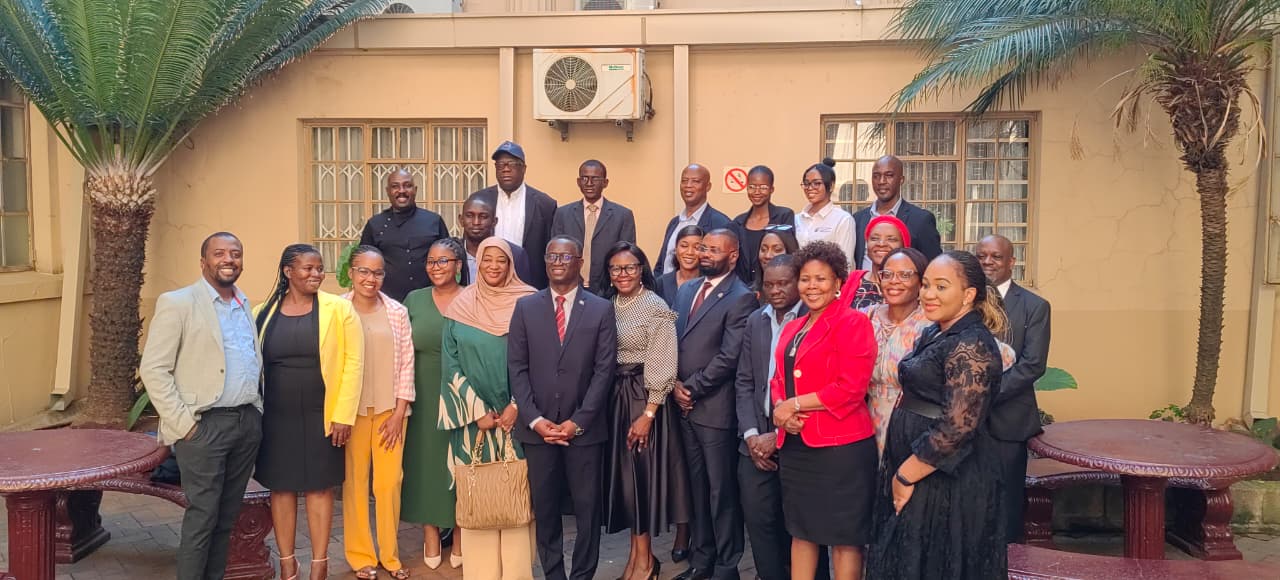
The Ministry of Higher Education, Research, Science and Technology (MoHERST) is pleased to announce the successful conclusion of a historic eleven-day strategic study tour to the Republic of South Africa, undertaken under the auspices of the World Bank-funded Resilience, Inclusion, Skills, and Equity (RISE) Project. The mission, led by Hon. Minister Prof. Pierre Gomez, has returned with transformative insights, concrete partnership commitments, and an actionable implementation roadmap that will shape the trajectory of The Gambia's education, research, and innovation systems for generations to come.
A MISSION ROOTED IN PURPOSE, GROUNDED IN PARTNERSHIP
From January 24 to February 4, 2026, the nine-member delegation engaged with some of South Africa's most distinguished institutions and policy bodies, including the Department of Higher Education and Training (DHET), the National Research Foundation (NRF), the Department of Science, Technology and Innovation (DSTI), the Technology Innovation Agency (TIA), the South African Qualifications Authority (SAQA), the Quality Council for Trades and Occupations (QCTO), UMALUSI, leading Sector Education and Training Authorities (SETAs) and TVET Colleges among others. These engagements were not ceremonial. They were strategically designed to extract the deepest possible operational, governance, and financing lessons from one of Africa's most sophisticated tertiary education and innovation ecosystems.
Hon. Minister Prof. Pierre Gomez set the tone from the very first session, framing the mission not as a conventional knowledge transfer exercise, but as an act of pan-African solidarity, grounded in the philosophy of Ubuntu and the shared conviction that African nations must build upon each other's successes. "We did not come to copy," the Minister stated. "We came to learn, to adapt, and to rise, together."
KEY OUTCOMES: A TRANSFORMATION BLUEPRINT DELIVERED
The study tour yielded a wealth of strategic outcomes, including deep engagements across five critical thematic pillars:
1. TVET Governance and Institutional Architecture: The delegation gained comprehensive exposure to South Africa's tri-sectoral Post-School Education and Training system, the role of DHET in balancing national policy with institutional autonomy, and the multi-layered quality assurance framework underpinning the country's vocational landscape. These lessons will directly inform the design of governance structures for The Gambia's planned Centres of Excellence under the RISE Project.
2. Financing and Sustainability: Through hands-on engagement with SETAs, the National Skills Fund, and the SETA levy-grant mechanism, the delegation acquired critical knowledge on sustainable financing models, particularly as The Gambia works to operationalise its own Skills, Innovation, and Entrepreneurship (SIE) Fund beyond the RISE Project lifecycle.
3. Research Governance and National Innovation Policy: Engagements with the NRF and DSTI provided invaluable guidance on structuring a national research funding body, establishing accountability frameworks such as Annual Performance Plans, and building a postgraduate talent pipeline, all at the precise moment that The Gambia's National Research and Innovation Fund (NRIF) is being assembled.
4. Innovation Ecosystems and Commercialisation: The TIA visit illuminated pathways for bridging the gap between research output and economic value, lessons that will inform how The Gambia nurtures grassroots innovation alongside applied research.
5. Human Capital and Gender Equity: The delegation engaged in frank, forward-looking discussions on PhD pipeline development, competitive academic staffing, and the imperative of designing gender equity into every new STI instrument from the outset, not as an afterthought, but as an architectural feature.
EXCEPTIONAL DIPLOMATIC SUPPORT: A SPECIAL TRIBUTE
The success of this mission would not have been possible without the extraordinary support rendered by The Gambia's Higher Commissioner to South Africa, Her Excellency, Ambassador Fatoumatta Jahumpa Ceesay and her dedicated team (Hon. Buba Ayi Sanneh and Mr. Ousman Rambo Jatta, Mr. Alieu Saine and the drivers, Thabo and Dingwan, among others). From the initial coordination of high-level institutional engagements to the seamless logistical facilitation throughout the tour, the Higher Commissioner's office demonstrated exemplary professionalism, cultural sensitivity, and a genuine commitment to the mission's objectives. Their efforts ensured that every engagement was not only well-organised but positioned for maximum strategic impact.
Particularly noteworthy was the office's facilitation of a meeting with the Mauritian Embassy, an engagement that opened a valuable additional diplomatic and educational cooperation channel, underscoring The Gambia's ambition to diversify its partnerships and strengthen its continental and island-state relationships in the knowledge economy. This initiative reflected the broader diplomatic intelligence and initiative that characterised the Higher Commissioner's support throughout.
Hon. Minister Prof. Pierre Gomez personally extended his profound gratitude to the High Commissioner and her team, affirming that their work behind the scenes was nothing short of exemplary, and that The Gambia's diplomatic corps played a critical role in elevating this mission from a routine tour to a landmark strategic engagement.
THE ROAD AHEAD: FROM INSIGHT TO ACTION
The delegation returns not with recommendations filed away, but with a clear, time-bound action framework. Within the next 30 to 60 days, MoHERST will move to establish the Annual Performance Plan with NRIF, submit a formal expression of interest to join the Science Granting Council Initiative (SGCI), and table a Cabinet paper on the proposed Interministerial Committee on STI, and the establishment of a National Science Academy, among other immediate priorities. These are not aspirational targets. They are commitments.
Over the coming months, the Ministry will pursue the formalisation of institutional partnerships through Memoranda of Understanding with South African counterpart institutions, launch The Gambia's first comprehensive labour market intelligence study, and advance the legislative and policy frameworks needed to sustain the TVET and research transformation well beyond the RISE Project window.
A MOMENT OF RECKONING, AND OF RESOLVE
This study tour represented far more than a learning mission. It was a reckoning, an honest assessment of where The Gambia stands, and an energising confirmation of where it can go. South Africa's journey from 16 to 57 Centres of Specialisation over eight years, its candid acknowledgement of its own challenges around donor dependency and staffing, and its generous willingness to share both its triumphs and its stumbles have handed The Gambia something invaluable: a realistic, navigable map.
The Gambia has a rare and significant strategic advantage. Both its TVET system and its research and innovation system are being built simultaneously. If that integration is engineered deliberately, now, while both systems are still nascent, The Gambia will not merely follow South Africa's model. It will improve upon it.
As Hon. Minister Prof. Pierre Gomez declared upon the delegation's return: "We did not rise alone. We rose together, as Africans, as partners, and as a nation that has decided its future will not be left to chance."
Copyright © 2026. All Rights Reserved